League of Nations
Last and First MenThe League of Nations is the recurring but imperfect institution through which the First Men try to turn the desire for peace into international cooperation. It gains authority as a focus for loyalty beyond the nation, helps former enemies rebuild together, and eventually oversees restrictions on essential fuels. Yet its history exposes the limits of a body composed of governments whose peoples remain vulnerable to national fear: it can prevent many lesser conflicts, but repeatedly fails when the great powers divide or go to war.
Reconstruction and the promise of unity
The League’s practical importance is clearest after the Anglo-French War. France and England are so devastated by famine, pestilence, and social breakdown that neither can manage its own recovery; the League temporarily takes over the administration of both countries, and each relies substantially on outside help. Its role is not simply to end hostilities. The former enemies cooperate in reconstructing both nations, a reversal of the earlier settlement after the European War, when disputes over reparations and security had kept national suspicion alive. After this later catastrophe, patriotism temporarily recedes, and the two peoples help rebuild one another.
The change is linked to several conditions: national organization has collapsed, pacifist and anti-nationalist Labour has rapidly gained dominance in both countries, and the League is strong enough to investigate and publish the origins of the war. By exposing each combatant’s conduct to its own people and to the world, it makes a shared account of responsibility possible. Its authority here rests on more than diplomatic procedure: it can make the facts of conflict public at a moment when the belligerents are too exhausted to sustain their former hatred.
The League also becomes a concrete meeting point for a broader, still precarious loyalty to humanity. It is not a world government: it is an association of national governments, each chiefly concerned with preserving its sovereignty. At first, its survival depends on extreme caution toward the great powers. Over time, however, it acquires enough moral authority that even the mightiest member is reluctant openly to defy its will or reject the findings of its High Court. The institution’s growth therefore reflects a real change in political allegiance, but not the disappearance of national self-interest.
Authority tested by national conflict
The League’s failures reveal the difference between possessing authority and being able to command loyalty. The Anglo-French War begins in a world where a genuine movement toward unity exists, but lacks clear guidance and the courage of conviction. Later, distrust of human nature itself becomes a political force: people who think of themselves as Europeans fear that a sudden outbreak of patriotism could draw them into another destructive conflict. This fear helps produce the European Confederacy, in which all European nations except Russia surrender sovereignty to a common authority and pool their armaments. America interprets the arrangement as directed against itself and withdraws from the League, while China remains within it in the hope of using it against its rival.
The Confederacy initially appears unified from outside, but remains insecure within and breaks during serious crises. The League, too, is repeatedly set aside when national loyalties harden into rival camps. The Russo-German War becomes possible because the United States favours Russia while China favours Germany. The League’s inability to prevent that war does not make it irrelevant: its standing has helped express a cosmopolitan ideal, but the international system still allows competing powers to turn economic and sentimental antagonisms into armed conflict.
After the destruction of Europe, the League stands for a time on one side and the United States on the other. It is then dominated by China and no longer represents cosmopolitanism in the same way. Those whose loyalty remains genuinely human work to bring the United States back into the organization, and eventually succeed. The reversal underscores a central weakness: the League may embody an international principle, but its character and reach depend on the balance of the governments within it.
Preventing lesser wars, dividing into rival Leagues
Despite its failure to stop the great wars, the League works effectively against the many lesser conflicts that had once been a chronic affliction. For a period, global peace is secure except when the organization itself is nearly divided. That qualification becomes increasingly important as the United States and China rise in power. An attempt to remake the League as a cosmopolitan sovereignty, with control over all nations’ pooled armaments, meets the same obstacle that has limited the institution throughout its history: tribal loyalties prove stronger than the will to common government.
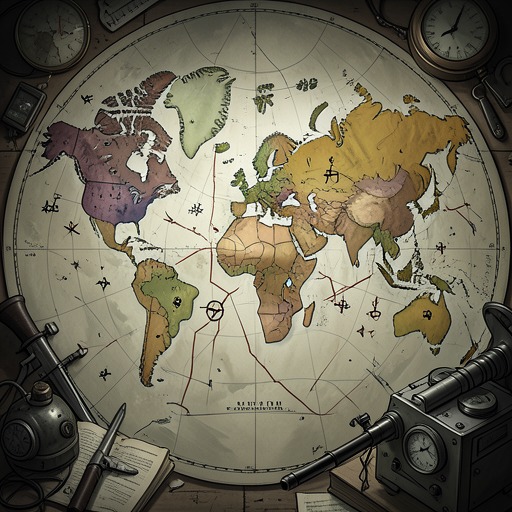
The dispute over Japan brings the breakdown into the open. The League splits into two bodies, each claiming to inherit universal sovereignty from the old organization, while each is in practice dominated by one of the rival supernational loyalties, American or Chinese. Within a century of Europe’s eclipse, the division has become a political and mental crystallization: a wealthy American Continental Federation faces an Eastern system organized around Asia and Africa. The League’s transformation from a focus for human unity into competing instruments of rival blocs marks the narrowing of its original promise.
Fuel governance and institutional legacy
The League’s most important practical achievement is its cosmopolitan control of fuel. After a severe oil famine, it imposes joint control over existing oil and coal fields and restricts how these resources may be used. Oil is reserved for enterprises for which no other power source will serve. This policy outlasts the League itself, becoming a fixed principle of the race even after the organization has been superseded. Its reach thus extends beyond the League’s active political life: shared resource governance survives as an inherited institution and habit.
That success carries an unintended historical consequence. When large fuel deposits in Antarctica are found to lie beyond the jurisdiction of the World Fuel Control Board, the United States moves first to exploit them, while China demands that the new sources be brought under the Board. Their dispute contributes to the return of nationalistic feeling and makes war seem increasingly inevitable. Later, the League’s fuel policy helps postpone the exhaustion of coal until a period when human intelligence has deteriorated too far to manage the resulting crisis. A policy described as unusually sane therefore contributes, by delaying the reckoning, to the eventual collapse of civilization.
The League’s legacy is deliberately double. It gives international cooperation a durable institutional form, aids reconstruction, checks many lesser conflicts, and establishes a far-reaching system for governing scarce energy. But it cannot abolish the loyalties and fears that repeatedly divide its members; nor can a sound policy guarantee that later societies will be capable of adapting when its consequences change. The League’s history is the history of a real advance in collective responsibility that never becomes secure enough to master the forces it was created to restrain.